Captions:
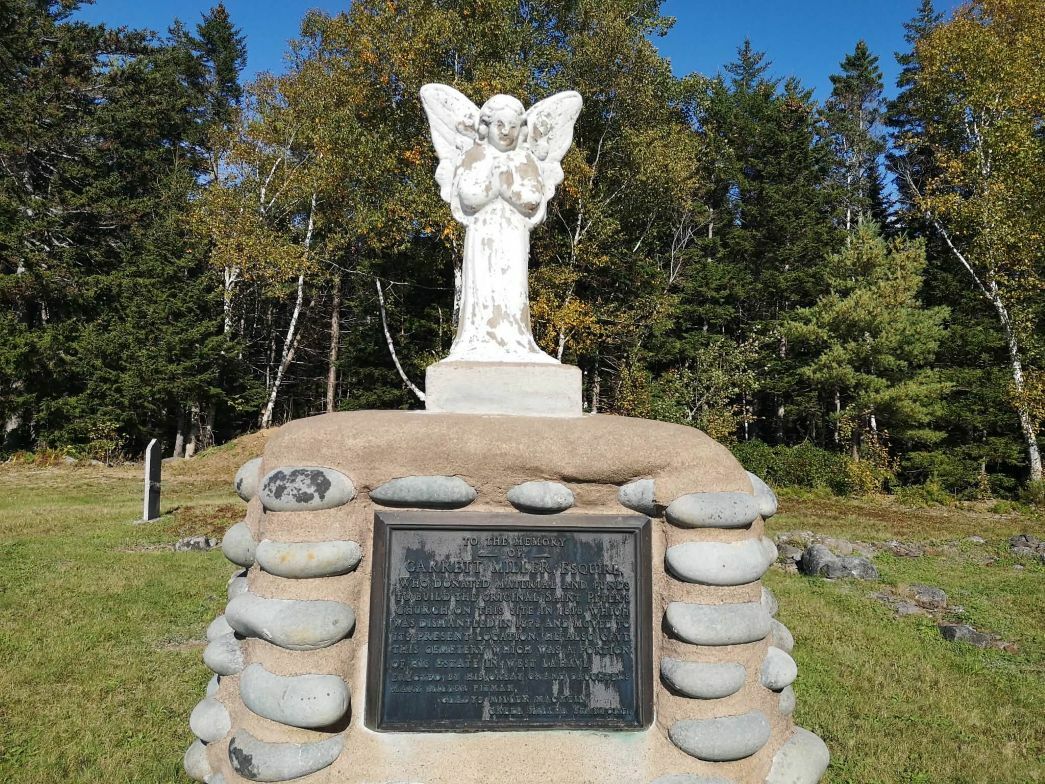
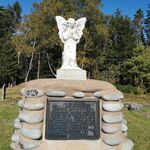
The cairn for Garrett Miller
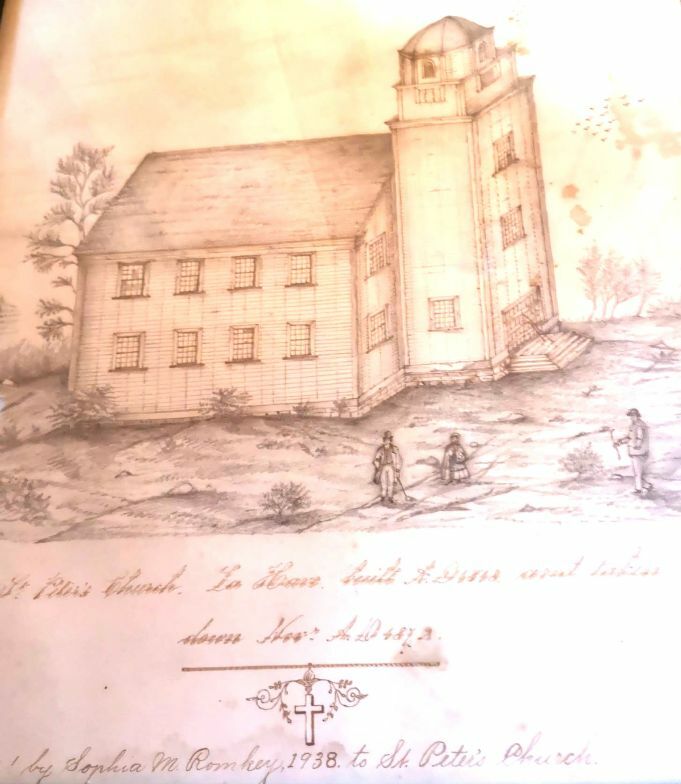
Sophia M. Romkey’s sketch of St. Peter’s, which is in the St. Peter's Vestry
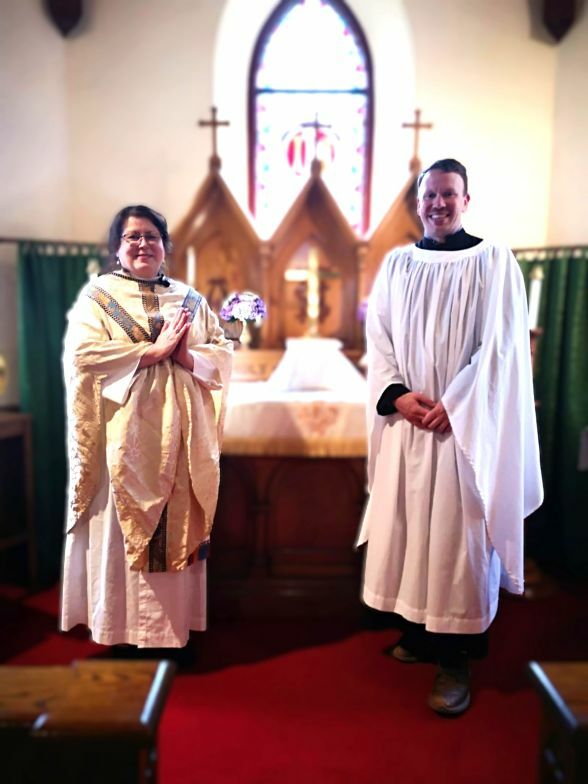
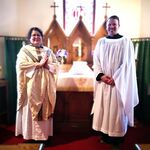
Rev. Taunya and Postulant Cory Lunn, after celebrating St. Mary Magdalene’s Day, 2025, in St.
Peter’s, West LaHave
While searching the records of the Parish of New Dublin for a baptism, I came across
an entry in the vestry books dated April 13, 1868, for the newly formed St. Peter’s
Parish, New Dublin. It included West Dublin, Lower Dublin, Mount Pleasant, Fralig’s
Settlement, and Pentz. The Rector at the time was the Rev’d A. Jordan. The
communities described were originally a part of the Parish of Lunenburg, which had also
included communities up to the Port Medway River. This was a turning point in the
history of the area. A number of churches would be built, but they all had roots with St.
Peter’s, known as the “Mother Church.”
The founding of the Church of England in the area was ambitious. Garrett Miller, the son
of Jacob Miller, a prosperous Loyalist businessman who attended St. Paul’s, owned
land in West LaHave Ferry that was given to him by Col. Joseph Pernette when he
married his daughter Catherine. The closest Anglican Church that he could attend was
St. John’s Lunenburg. No doubt this prompted him to consider a church for the area.
The West LaHave area had originally been settled by Col. Joseph Pernette in 1765,
who had received a grant of 22,100 acres of land. A small community developed to
support his farm.
St. Peter’s, West LaHave Ferry, opened in 1820 with a service officiated by the Rev.
Roger Aitken, of St. John’s, Lunenburg. Two years before, on December 1, 1818,
Garrett and Catherine Miller granted a deed of land to the Right Reverend Stanser and
seven others for a sum of five shillings. The design for the church was similar to St.
John’s Lunenburg. Aitken would later note in a letter to Stanser that while the outside
was completed, the inside remained unfinished due to the lack of donations. It was a
major undertaking for a community that Garrett Miller had described as “very poor.”
The original grantor Garrett Miller asked Bishop John Inglis, as a member of the Board
of the SPG, for further grants since the people had subscribed less than 250 pounds.
He also noted that the cost of the building had grown to 850 pounds. Clearly, there was
hope for the growth of the church in the area. The SPG would later grant 200 pounds.
Garrett would take care of the financial records of the parish until his death in 1870.
Original subscribers included Bishop John Inglis, Hon. R.J. Uniacke, Samuel Cunard,
and Lord Dalhousie. Garrett had donated 200 pounds and much of the building material.
Two years after his death the church would be torn down, and a new St. Peter’s would
be built.
Miller’s daughter Greta described the church as having a “… double row of windows on
each side and a gallery at one end.” She noted that it stood “… on one of the most
lovely spots on the river, commanding a view both up and down the stream.” The
church was conveniently located near the West LaHave Ferry, which ran from a wharf
on Pernette’s Homestead. His son John would officially run the ferry in 1830.
The church was an ambitious undertaking given the fact that most of the congregation
had initially been unfamiliar with the Church of England liturgy. While the community
couldn’t contribute abundant funds, they were faithful, with nearly 400 attending
services.
On Nov. 18, 1834, St. Peter’s was consecrated. This massive undertaking had finally
been completed. On March 27, 1837, St. Peter’s became a separate parish from St.
John’s, Lunenburg. It was known as the Parish of Petite Rivière and New Dublin. The
church would remain open until 1867, when it was decided to build a new church at the
crossroads. Much of the original timber was used.
Ordained in 1829, the Rev. Joshua Wingate Weeks became the first priest to reside in
West LaHave Ferry; he often travelled as far as Vogler’s Cove. He ministered in the
expansive area for nearly 25 years.
In 1847 Rev. Robert Brine settled in Petite Rivere and served St. Peter’s, West LaHave,
Union Church, New Dublin, built around 1842, and St. Mark’s Broad Cove, built in 1840.
The parish was developing westward.
So if you have an opportunity to tour Highway 331, take the opportunity to visit the site
of the old St. Peter’s Church in the St. Peter’s Cemetery. There you will find a cairn
dedicated to Garrett Miller. Let us give thanks for his dedication to the Church of
England.