While recently searching records on the Society for the Propagation of the Gospel
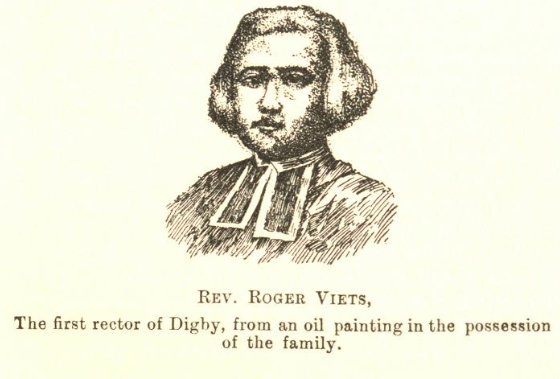
(SPG) and its missionary activities, I was reminded of the Rev’d Roger Viets, someone
who played a key role in the establishment of both the Town and the Parish of Digby.
Over 1,330 United Empire Loyalists arrived in Digby in 1783. They were a part of the
over 46,000 Loyalist refugees who fled the political persecution and violence that
followed the American Revolution. Although Viets is not commemorated in the modern
Anglican Calendar, we might perhaps pause to remember his birthday, 288 years ago
on March 9.
Roger Viets was born in Simsbury, Connecticut, the second son of Captain John Viets
and Lois Phelps. This was perhaps a quiet beginning for someone whose life would be
drastically changed by the conflict between the Thirteen Colonies and Great Britain. His
father would later become keeper of the Newgate Prison and well-known as a supporter
of the Revolutionary cause. His parents might not have expected that he would attend
Yale, convert from Congregationalism to Anglicanism, and become a supporter of the
Loyalist cause. Or that he would later be ordained in London as an Anglican priest and
would become the Rector of Trinity Anglican in Digby, Nova Scotia.
Digby was seen as a place to settle since it was opposite Saint John, New Brunswick,
another Loyalist settlement, and advantageously situated near the entrance to the
Annapolis Basin, on the waterway known as Digby Gut. The indigenous Mi'kmaw
inhabitants called the area “Oositookun,” meaning an ear — and indeed the
geographical outline of the waterways in the area perhaps suits the description!
The Rev’d Jacob Bailey, a Loyalist SPG missionary based in Annapolis Royal, first
visited Digby Town in 1785. He preached to large congregations and baptized many
children. Bailey was concerned about their spiritual welfare and urged the Society for
the Propagation of the Gospel to appoint an Anglican missionary. He argued that no
other part of the province needed a priest more than the Town of Digby. With Bailey’s
encouragement, a vestry was elected. On the day of their election, they named their
parish “Trinity,” since many of them had originally belonged to Trinity Parish in New
York.
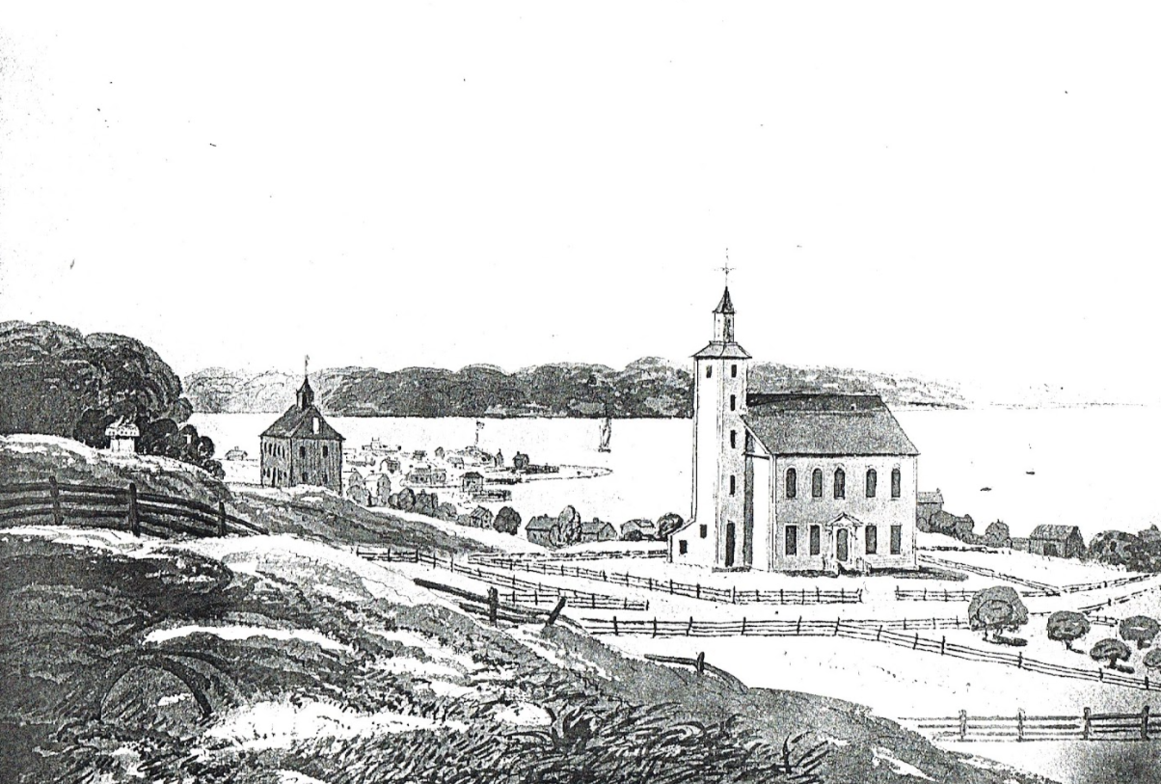
Viets arrived in Digby in July of 1786. He began his leadership by encouraging his new
flock to build a church. The vestry was able to raise a total of 176 pounds in money,
labour, and material through subscriptions. They were also granted 300 pounds from
the British government and received additional support from Admiral Digby. Viets
himself received a commitment from the vestry to pay him 25 pounds per annum, in
addition to the 50-pound stipend from the SPG. On 30 July 1788, Bishop Charles Inglis
laid the cornerstone of Trinity Church in Digby.
In July 1788, Viets attended a convention of Anglican clergymen in Halifax, where Inglis
invited him to preach a sermon. There, Viets delivered to Inglis and 10 Nova Scotian
Anglican missionaries his sermon, “On the Duty of Attending the Public Worship of
God.” He began his exhortation by stating his disappointment with the “Degeneracy of
the Times …”
His message was received by some. By 1791, the vestry believed that work on Trinity
Church had progressed enough to petition Bishop Inglis for consecration. In his 1792
annual report to the SPG, Viets assured the society that “… there [was] a visible
improvement in the morals and piety of his people and in their serious attention to the
administration of religion.”
His tenure was not without challenges. Emigration became a major issue for the new
settlement. Many of the settlers in Digby Town itself moved on to other communities,
including a number who would return to the United States. Having started out with 396
landowners, by 1795 there were only 128, of which 117 were Loyalists or sons of
Loyalists. In 1792, the outlying Anglican Black Loyalist community in Brindley Town was
severely hit by a wave of emigration to what was to become the African state of Sierra
Leone.
From 1800 to 1811, during Viets’ last decade, the number of communicants averaged
about 31. Although he did not increase the numbers in his flock, he managed to keep a
steady number of supportive parishioners during difficult times. By the time of his death,
many of the original founders of Trinity Church had also died. His son, Roger Moore
Viets, was inducted as the Rector of Trinity Church in 1815. The Anglican presence in
Digby remained, and in 1878 a new church would be built, which exists to this day.
The last decade of Viets’ life was dominated by his efforts to inhibit the growth of the
Protestant “Dissenting” denominations in his parish. The SPG supplemented his salary
when he travelled to the outlying communities such as New Edinburgh, Clements, and
Sissiboo, but his main support remained within the town. However, as the many non-
Anglican churches throughout Digby County today testify, the various Dissenters found
greater success in the rural areas.
The records tell us that the Rev’d Roger Viets died of consumption on August 6, 1811,
following a foggy voyage to Annapolis. Let us give thanks for his faithful ministry and for
accepting that invitation to come to Digby and lead the flock of Trinity Church.